Solar Panel Installer St Helens (solar for St Helens homes) / Homes
Solar on St Helens's 1960s and 1970s homes
More of St Helens's homes date from 1965 to 1982 than from any other period: 22.9% of them, against 18% across England (council tax records, March 2026). The years 1965 to 1972 alone account for 15.4%. These houses are often the easiest roofs in the borough for panels.
Sources read on 3 November 2026. Published by SEO Dons, which runs this St Helens site.
When St Helens was built
| Built | St Helens | England |
|---|---|---|
| Before 1919 | 15.8% | 19.9% |
| 1919 to 1939 | 17.9% | 14.7% |
| 1945 to 1964 | 18.3% | 16% |
| 1965 to 1982 | 22.9% | 18% |
| 1983 to 1999 | 10% | 11.8% |
| 2000 to 2026 | 14.8% | 18.8% |
HMRC Council Tax stock of properties, 31 March 2026 (our percentages; there is no 1940 to 1944 band).
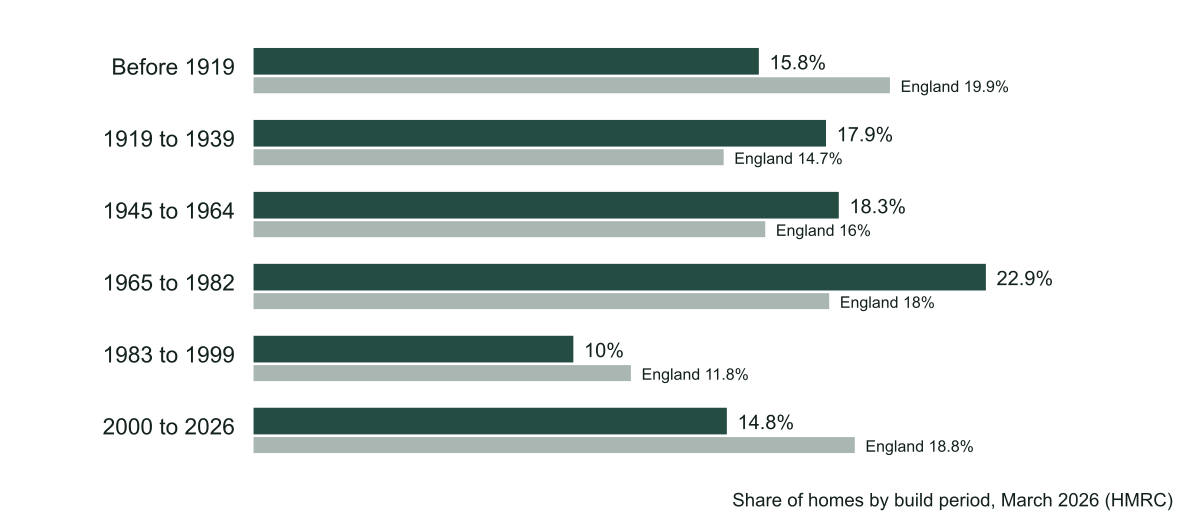
The borough has fewer homes built before 1919 than you might expect for an old industrial town: 15.8%, below England's 19.9% and well below Merseyside's 24.6%. Instead it has more of almost everything built between 1919 and 1982, with the peak in the late 1960s and early 1970s. Semi-detached houses are the commonest type, home to 47% of households.
Why these roofs suit panels
- Simple shapes. Plenty of houses from this era have plain gable-ended roofs with long, unbroken slopes, which take panels in neat rows.
- Few stacks. Houses of this era often have one small flue or none rather than a row of chimney stacks, so there is less on the roof to work around and less to cast shade.
- Concrete tiles. Interlocking concrete tiles are quick to lift and refit round a bracket, and rarely break.
- Usable lofts. Trussed-rafter roofs of the period leave room for cable runs, though the trusses must not be cut or overloaded.
Questions for the survey
- Where will the inverter and isolators go: the loft, a garage, an outside wall? Is there room and access?
- Is the consumer unit suitable for the connection, or does the price include replacing it?
- Has the roof been re-covered since it was built, and with what? Heavier replacement tiles change what the trusses carry.
- If the home may qualify for the Warm Homes: Local Grant, would the scheme look at insulation as well as panels?
Repairs while the scaffold is up
If felt or battens round the brackets turn out to need work, the cheapest moment to do it is while the scaffold is already there. Ask the installer to price likely repairs in advance as an optional line, so that a surprise found on the day is a known cost rather than a negotiation at the top of a ladder.
What to check
- The pitch. Some houses of the period have shallow roofs. Output on a south roof drops only slightly at lower pitches, but the mounting kit must suit the pitch.
- Trussed rafters. Brackets must be fixed into the rafters without cutting or notching the trusses. Ask how the installer will fix them.
- The underlay and battens. Felt and battens fifty years old may be brittle. If the installer finds them failing round the brackets, that is a repair to price before, not after.
- Neighbours' extensions. Later two-storey extensions next door can shade a once-clear slope. Run them through the shade checker.
- Energy rating. Only 43.77% of the borough's homes built between 1930 and 1982 are rated C or better (ONS). If yours is D or below, the Warm Homes: Local Grant may be worth checking.
Related pages
References
- Council Tax stock of properties, 2026 (HMRC)
- Office for National Statistics: how energy efficient are homes in England and Wales
- Nomis: Census 2021 table TS044, type of accommodation
- PVGIS 5.3 photovoltaic estimates (EU Joint Research Centre)
- MCS MIS 3002 version 6.0: the solar PV installation standard
- Town and Country Planning (General Permitted Development) Order 2015, Schedule 2 Part 14
Questions about 1960s and 1970s homes
Are 1960s and 1970s houses good for solar panels?
Often. Many have simple pitched roofs with few stacks, concrete tiles that are quick to work with, and lofts with room for an inverter. Check the roof covering and the pitch: some homes of this era have shallow roofs or interlocking tiles that need the right brackets.
My 1970s house has a shallow roof. Does that matter?
Not much for a south-facing roof: output falls only a few per cent between 35 and 20 degrees. For an east or west roof a shallower pitch is slightly better. Below about 10 degrees, the mounting kit must be rated for it.
Should I insulate before fitting solar?
They do different things: insulation cuts the heat you need, panels make electricity. Neither waits on the other. If you plan loft insulation, do it before or at the same time, because fitters will be working in the loft for the panels' cables.
Get a solar quote for your St Helens roof, shade and all
Tell us what you would like a quote for, with your St Helens postcode and what stands to the south of the roof: a stack, the houses opposite or a tree. Your details go to SEO-DONS LTD, publisher of Solar Panel Installer St Helens, and we reply by email.
What happens next
- Send the form: it reaches SEO-DONS LTD, and a full postcode tells us which part of the borough you are in.
- We read it and reply by email, with the figures and sources that apply to you.
- Asking for a quote costs nothing, and whether and with whom you go ahead is your decision.