Solar Panel Installer St Helens (solar for St Helens homes) / Shade
Chimney stacks and solar panels: how much do they really shade?
Older St Helens streets are full of chimney stacks, often several to a short terrace, and they sit right where panels would go. Here is how much shade a stack actually causes, worked out for typical positions, and how to plan round one.
Sources read on 3 November 2026. Published by SEO Dons, which runs this St Helens site.
Five stacks, worked out
| Stack | Whole year | December | June |
|---|---|---|---|
| Stack 4 m due south (for example on a back extension) | 2.6% | 28% | 0% |
| Stack 8 m due south | 0.0% | 0% | 0% |
| Stack 2.5 m to the south-east | 2.2% | 5% | 0% |
| Stack 2.5 m to the south-west | 2.5% | 3% | 0% |
| Stack 3 m due east, level with the panels | 0.9% | 0% | 0% |
Our calculation with the shade checker: the 4 m and 8 m stacks stand 1.5 m above the bottom of the panels and are 1.2 m wide; the closer stacks 1 m above and 0.8 m wide (1.2 m above and 1 m wide for the one due east). Weighted by clear-sky direct sunshine; a comparison, not kWh.
How many stacks a St Helens street has
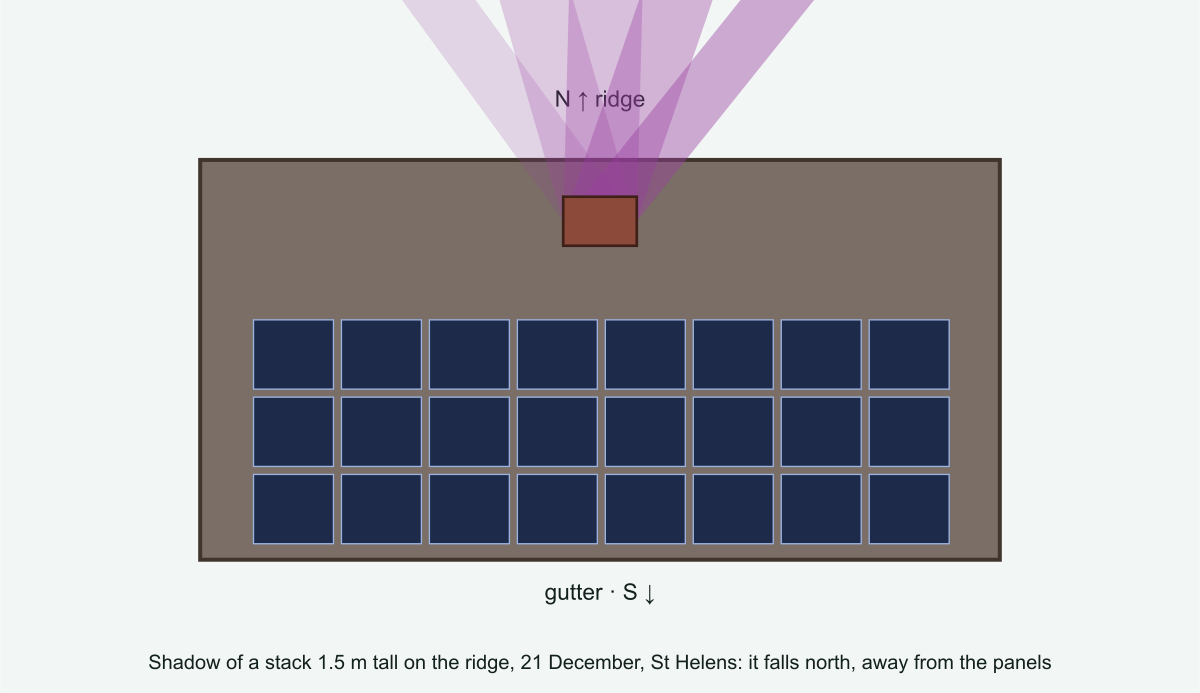
Plenty. In Vulcan Village at Newton-le-Willows, built in 1835 for the workers of the Vulcan Foundry, the conservation appraisal records stacks along the ridges with "eight clay pots per stack, with one stack for two houses", and rear outriggers added in the 1950s. Older terraces elsewhere in the borough often share stacks between neighbours along the ridge in a similar way. On a south-facing slope, stacks on your own ridge cast their winter shadows north, away from the panels. The stacks that can reach the panels are those to the south of them: on back extensions, or on the houses across the alley.
Why stacks matter less than they look
A stack is narrow, so from the panels it covers only a thin slice of the sky, and the sun passes through that slice for an hour or two at most. It is also usually not much taller than the roof around it, so the sun is only behind it when it is low, which means winter. Put those together and the shadow falls on the panels mainly between November and February, when the roof makes little anyway.
Why they still cost you
- Lost space. Panels cannot sit over the stack or its flashings, and need clearance from them. On a short terrace roof, a stack in the middle of the slope can split the array into two small groups.
- String effects. A shaded panel can hold back the other panels wired with it, so the loss is larger than the shaded area alone; see optimisers and microinverters.
- Close stacks. A stack a couple of metres to the south-east or south-west of the panels covers a wider slice of sky than one further away, and its shadow can reach them in spring and autumn too.
- Ridge stacks on east or west roofs. On an east- or west-facing slope, stacks along the ridge sit beside the panels, and their shadows cross the slope in the mornings or evenings.
Planning round a stack
- Measure the stack's height above the bottom of where the panels would go, its distance and its width, and run it through the shade checker.
- If it only matters in winter, plan the panels round it and accept the small loss.
- If it shades through the spring and autumn, keep panels out of its path, or ask about optimisers on the panels it reaches.
- If the stack is redundant and you were going to remove it anyway, do that first, with any consent it needs, and re-roof the patch before the panels go on.
Related pages
References
- NOAA Global Monitoring Laboratory: general solar position calculations
- MCS MGD 005: solar PV shade evaluation procedure (shade factor)
- St Helens Borough Council: Vulcan Village conservation area appraisal
- Town and Country Planning (General Permitted Development) Order 2015, Schedule 2 Part 14
- National Heritage List for England (Historic England)
Questions about chimneys
Can solar panels go round a chimney?
Yes. Installers leave a gap round the stack and its flashings, and often keep panels out of the strip the stack shades for much of the year. The shade checker here shows how much that strip matters for your stack.
Should I take my chimney down to fit more panels?
Only if it is redundant and you would remove it anyway. Removing a stack is building work in its own right, and in a conservation area or on a listed building it may need consent. Most stacks cost a panel or two and a little winter output, which rarely justifies the work on its own.
Does a stack to the north of my panels matter?
Not for shade on a south-facing roof: the sun is never in the north at the heights that would matter. It does affect where panels can physically go, because they need clearance from the stack and its flashings.
Get a solar quote for your St Helens roof, shade and all
Tell us what you would like a quote for, with your St Helens postcode and what stands to the south of the roof: a stack, the houses opposite or a tree. Your details go to SEO-DONS LTD, publisher of Solar Panel Installer St Helens, and we reply by email.
What happens next
- Send the form: it reaches SEO-DONS LTD, and a full postcode tells us which part of the borough you are in.
- We read it and reply by email, with the figures and sources that apply to you.
- Asking for a quote costs nothing, and whether and with whom you go ahead is your decision.